Choosing a generator for a home requires more than comparing advertised wattage. The process begins with understanding how household appliances consume electricity during normal operation and startup. This guide explains how to size a generator for a house using practical load calculations, appliance nameplates, and realistic backup priorities. A refrigerator may need modest running power but several times more power when its compressor starts. Well pumps, air conditioners, freezers, and electric heaters can create similar surges. These brief demands often determine the generator size.
A dependable estimate separates essential loads from optional comforts. Lights, refrigeration, communication equipment, a sump pump, and medical devices may deserve priority during an outage. Add their running watts, then account for the largest starting surge instead of simply adding every appliance’s maximum rating. Leave a sensible capacity margin for cold weather, aging equipment, and future changes. Small details matter. A furnace fan can surprise you. An electric water heater can consume thousands of watts.
Yet no estimate is perfect. Nameplate information may be missing, confusing, or inaccurate. A qualified electrician can verify circuits with a clamp meter and confirm safe connection methods. Transfer switches, grounding, ventilation, fuel storage, and local electrical requirements also affect the final choice. Never connect a portable generator directly to household wiring without approved equipment. That shortcut can endanger people and damage the electrical system. This article offers a careful starting point, while professional inspection remains the safer decision for complex homes, large loads, or standby installations.
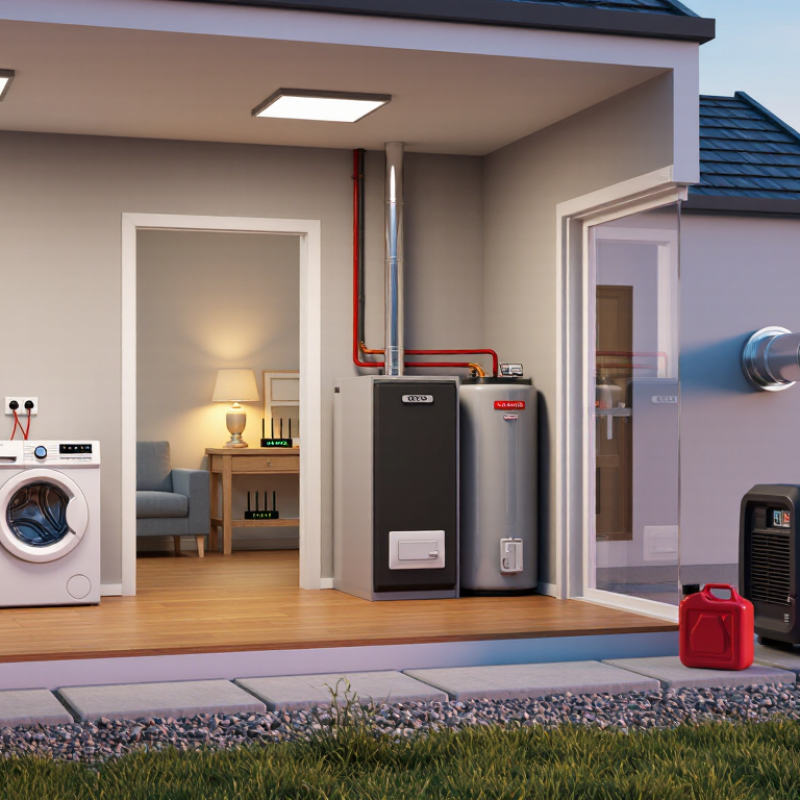
Understanding a Home’s Electrical Load and Power Requirements
Sizing a home generator starts with the electrical load, not the house’s floor area. A small home can still demand substantial power. List every appliance you may use during an outage. Include refrigerators, pumps, heating equipment, lighting, internet equipment, and medical devices. Record each item’s running watts and starting watts. Motors often need two to three times more power briefly. That short surge can trip an undersized generator. Keep it practical.
Separate essential circuits from convenient ones. Refrigeration, water pumps, selected lights, and heating equipment may be critical. Ovens, clothes dryers, pool equipment, and vehicle chargers need careful prioritization. Add the running watts of essential loads. Then compare the largest starting surge against the generator’s surge rating. Do not simply add every nameplate value. Some equipment cycles instead of operating continuously. A load-management plan can reduce the required capacity.
A qualified electrician should verify the calculation and inspect the service panel. A correctly rated transfer switch helps prevent unsafe backfeeding. Follow local electrical codes and use reliable equipment data. Consider altitude, outdoor temperature, fuel availability, and maintenance access. Generator output may decline in high elevations or extreme heat. No estimate is perfect. Leave reasonable headroom, but avoid excessive capacity without need. More capacity can mean higher fuel use, heavier wiring, and greater installation costs. Recheck the list when household equipment changes. A forgotten sump pump can alter the result.
Listing Essential Appliances and Their Starting Wattage
China Best Generator: How to Size a Generator for a House?
Listing essential appliances is the most reliable starting point. Record each appliance’s running wattage and starting wattage separately. A refrigerator may use 150–700 running watts, but its compressor can briefly demand 1,200–2,000 watts. A sump pump may require 800 watts while operating and 2,000 watts during startup. Window air conditioners, well pumps, freezers, and furnaces also create sharp surges. LED lights use little power, often 10–15 watts each. Microwaves commonly need 1,000–1,500 watts.
Write everything down.
Add the running watts of appliances you may use together. Then add the highest starting surge, not every surge at once. For example, a refrigerator, several lights, and a microwave might need about 2,500 running watts. If the refrigerator starts first, the generator should handle that extra surge. My early estimates were often too low because I ignored motor startup. Real homes are less predictable than a worksheet.
Tips: Check the data plate on every appliance, especially pumps and heating equipment. Choose a generator with some spare capacity, ideally 20–25 percent. Test the setup before an outage, with doors closed and normal household loads connected. An electrician can verify transfer equipment and grounding requirements. Manufacturer labels can be confusing, and some appliances list input watts rather than actual operating demand. Record your measurements again after testing; the first list may be wrong.
China Best Generator: How to Size a Generator for a House?
Essential household appliances can require significantly more power when their motors start. Use the estimated running and starting wattages below to compare generator capacity requirements. Actual values vary by appliance model and operating conditions.
Generator sizing tip: Add the running watts of appliances that may operate at the same time, then include the highest starting-wattage surge from motor-driven equipment. Select a generator with additional capacity for safety and future loads.
Calculating Running Wattage and Peak Starting Demand
China Best Generator: How to Size a Generator for a House?
Calculating running wattage is the practical starting point. List every appliance you may use during an outage. Record its running watts from the nameplate or manual. Add the refrigerator, lights, internet equipment, sump pump, heating system, and cooking devices. A refrigerator might run at 700 watts, while its compressor briefly needs 2,000 watts. These figures vary with age, temperature, and condition.
Peak starting demand needs separate attention. Motors in pumps, freezers, air conditioners, and fans can require two to seven times their running wattage. Add the largest starting surge to the total running load of other appliances operating at that moment. For example, 3,500 running watts plus a 2,000-watt pump surge requires about 5,500 watts. Avoid adding every appliance’s starting surge together unless they truly start simultaneously.
Leave a sensible margin, often 20 to 30 percent, for cold starts and future equipment. A transfer switch and qualified electrician can improve safety and prevent back-feeding. I once underestimated an old freezer because its label showed only running watts. The generator struggled during startup. That mistake showed me why measured demand is better than a quick guess. Watt meters help, but appliance manuals and professional assessment remain more reliable. Two homes with identical floor plans may still need different generator sizes.
Choosing the Right Generator Capacity and Fuel Type
China Best Generator: How to Size a Generator for a House?
Choosing the right generator capacity starts with your actual household loads. List essential appliances, such as a refrigerator, water pump, lights, router, and heating system. Record each running wattage from its nameplate. Then check starting watts. Motors may briefly need two to three times more power. Add these figures, and keep a 20% safety margin. Do not size only by floor area.
For a typical small home, a 5–8 kW generator may support essential circuits. A larger house with electric heating, well pumps, or several air conditioners may need 10–20 kW. A load-management system can reduce peak demand, but it should be designed by a qualified electrician. A properly installed transfer switch also prevents dangerous backfeeding. Small details matter.
Fuel choice changes cost, storage, and reliability. Gasoline is easy to find, but it degrades during long storage. Diesel handles heavy loads well, although it needs regular maintenance and suitable ventilation. Propane stores longer and burns cleanly, but cold weather can affect supply pressure. Natural gas is convenient when the utility line remains active. It may fail during a major outage. I would not choose fuel by price alone. Test the generator under load every few months, and record faults honestly. Real household demand is often higher than the first estimate.
China Best Generator How to Size a Generator for a House? - Choosing the Right Generator Capacity and Fuel Type
| Household Load or Sizing Factor |
Typical Running Power |
Typical Starting Surge |
Sizing Consideration |
Recommended Fuel or Feature |
| LED lighting circuit |
100–300 W |
Minimal |
Add the actual wattage shown on the bulbs or circuit label. |
Any fuel type; low-load efficiency is useful. |
| Refrigerator and freezer |
100–800 W |
600–2,400 W |
Compressor startup can be several times higher than running power. |
Gasoline, propane, or natural gas; inverter output can protect sensitive controls. |
| Wi-Fi router, modem, and electronics |
50–300 W |
Minimal |
Use a generator with stable voltage and frequency for sensitive electronics. |
Inverter generator or generator with low total harmonic distortion. |
| Sump pump |
800–1,500 W |
1,600–4,500 W |
Check the motor nameplate because pump size and head pressure affect demand. |
Dual-fuel or natural gas for extended emergency operation. |
| Gas furnace blower |
400–800 W |
800–2,400 W |
The generator powers the blower and controls, not the natural gas burner. |
Natural gas or propane can simplify long outages. |
| Portable air conditioner |
1,000–1,500 W |
2,000–4,500 W |
Select a capacity that can start the compressor while other priority loads are operating. |
Gasoline or dual-fuel; soft-start technology may reduce surge demand. |
| Central air conditioner |
2,000–5,000 W |
4,000–15,000 W |
Use the compressor's rated-load and locked-rotor information for accurate sizing. |
A standby generator with an automatic transfer switch is usually the practical option. |
| Electric water heater |
3,000–5,500 W |
Minimal to moderate |
It is one of the largest continuous household loads and may need to be excluded. |
Natural gas or propane systems can reduce generator capacity requirements. |
| Electric range or oven |
2,000–5,000 W per active element |
Minimal to moderate |
Avoid counting every element unless they will operate simultaneously. |
Exclude from essential-load plans when possible. |
| Electric clothes dryer |
4,000–6,000 W |
Minimal to moderate |
Usually treated as a nonessential load during an outage. |
Exclude unless a large standby system is installed. |
| Electric vehicle charger |
3,600–11,500 W |
Usually low |
Charging power depends on the vehicle, charger level, and configured current. |
Normally exclude during an outage unless specifically designed for backup charging. |
| Generator Size Class |
Typical Continuous Capacity |
Typical Household Coverage |
Suitable Fuel Types |
Best Use Case |
| Small portable |
2–4 kW |
Lights, refrigerator, router, chargers, and a small pump |
Gasoline; some models support propane |
Basic emergency power with manually connected priority circuits |
| Medium portable |
5–8 kW |
Essential circuits plus a sump pump, furnace blower, or limited cooling |
Gasoline, propane, or dual-fuel |
Most common range for selected essential household loads |
| Large portable or compact standby |
9–14 kW |
Multiple essential circuits, well pump, furnace, and selected kitchen loads |
Dual-fuel, propane, or natural gas |
Larger homes with load management or a professionally installed transfer switch |
| Whole-house standby |
15–26 kW |
Most household circuits, subject to electrical service and load management |
Natural gas or propane |
Automatic backup for frequent or extended outages |
| High-capacity standby |
27 kW and above |
Large homes with several high-demand loads |
Natural gas or propane; diesel may be used in specialized installations |
High electrical demand requiring a professional load calculation |
Generator Sizing Method
Required running watts = the sum of all appliances expected to operate at the same time.
Required starting watts = the highest starting surge plus the running watts of all other operating loads.
Choose a generator whose continuous rating meets the running-load total and whose surge rating covers the highest startup demand. Allow approximately 10–20% spare capacity where practical, and have a qualified electrician install the transfer equipment.
Checking Transfer Switches, Installation, and Safety Requirements
Choosing the best generator for a house starts with safe installation, not only wattage. A properly rated transfer switch separates generator power from the utility supply. Without it, electricity can flow backward and seriously injure utility workers. Match the switch rating to the service panel and generator output. Neutral switching may also be required, depending on the electrical system. A qualified electrician should verify grounding, load calculations, permits, and local safety rules. Small details matter.
Installation requires a firm, level base, clear airflow, weather protection, and exhaust directed away from doors and windows. Keep fuel connections secure and maintain safe clearance from combustible materials. During commissioning, test voltage, frequency, phase balance, and automatic transfer timing. A realistic load test is important. Some systems start correctly but fail when pumps, refrigerators, and heating equipment operate together. That gap deserves attention. A rushed inspection remains a weak inspection.
Tips: List essential circuits before selecting the switch. Never connect a portable generator to a wall outlet. Install carbon monoxide alarms near sleeping areas. Keep the operating manual and maintenance records accessible. Test the generator periodically, but avoid testing indoors or in enclosed spaces. If the transfer switch hesitates, hums, or overheats, stop using the system and contact a qualified electrician. Recheck the installation after renovations.
FAQS
List each essential appliance and record its running and starting wattage separately. Add simultaneous running watts, then include the largest starting surge. Keep a 20–30% spare margin.
Motors can briefly demand two to seven times their normal power. Refrigerators, pumps, freezers, and air conditioners often create sharp surges. My first estimate was too low.
Microwaves may require 1,000–1,500 watts. A refrigerator may run at 150–700 watts but need 1,200–2,000 watts briefly. Pumps and heating equipment can also require substantial startup power.
Usually, no. Add the running load of appliances operating together, then add the largest realistic starting surge. Only combine multiple surges when they truly start simultaneously.
Check the data plate, manual, or a watt meter. Labels may show input watts instead of actual operating demand. Measure again after testing.
A 20–30% margin helps with cold starts, aging equipment, and future appliances. Real homes are less predictable than worksheets.
A properly rated transfer switch separates generator power from utility power. It must match the service panel and generator output. Neutral switching may also be necessary.
Use a firm, level base with clear airflow and weather protection. Direct exhaust away from doors and windows. Never connect a portable generator to a wall outlet.
Run realistic household loads, including refrigerators, pumps, lights, and heating equipment. Check voltage, frequency, timing, and transfer behavior. A rushed test can miss serious problems.
Ask a qualified electrician to verify grounding, permits, load calculations, and transfer equipment. Stop using the system if the switch hums, overheats, or hesitates. Small faults matter.
Conclusion
Learning how to size a generator for a house begins with understanding the home’s total electrical load and identifying which appliances must remain operational during a power outage. Make a detailed list of essential devices, such as refrigerators, lighting, heating or cooling systems, pumps, and communication equipment. Record both their running wattage and starting wattage, since appliances with motors may require a temporary surge of power when they start. Add the running wattage of all essential appliances, then allow sufficient capacity to cover the highest starting demand that may occur at the same time.
After calculating the required output, choose a generator with an appropriate capacity and a fuel type that suits your usage, storage options, and maintenance preferences. The installation should also include a properly rated transfer switch to prevent unsafe electrical backfeeding and to allow reliable switching between utility and generator power. Professional installation, adequate ventilation, grounding, routine inspections, and following local electrical and safety requirements are essential for dependable and safe operation.

 Gods Power