When a generator refuses to start, the cause is often simple but easy to overlook. A weak battery, stale fuel, or a loose safety switch can stop the engine completely. This guide explains how to troubleshoot a generator that won't start using a careful, practical process. It focuses on visible symptoms, basic checks, and manufacturer-approved solutions.
Start with basics. Confirm that the fuel valve is open and the tank contains clean, suitable fuel. Check the oil level on a level surface. Many modern generators shut down automatically when oil is low. Inspect the battery terminals for corrosion, then listen to the starter. A click may indicate weak battery power. No sound could suggest a switch, fuse, or connection problem.
Do not guess.
For recoil-start models, pull the cord steadily and notice resistance. A flooded engine may smell strongly of fuel but still fail to ignite. For diesel units, cold weather can affect glow-plug performance and fuel flow. Examine the air filter if the engine starts briefly, then stops. A clogged filter can restrict combustion.
Even experienced technicians can misread a symptom. A discharged battery may look like a starter failure. Old fuel may resemble an ignition problem. Record what happens during each attempt, including sounds, smells, and warning lights. Stop immediately if you see smoke, damaged wiring, fuel leakage, or unusual heat. Disconnecting power and consulting the owner’s manual is safer than forcing a repair. If basic checks fail, a qualified generator technician should test the electrical and fuel systems with proper equipment.
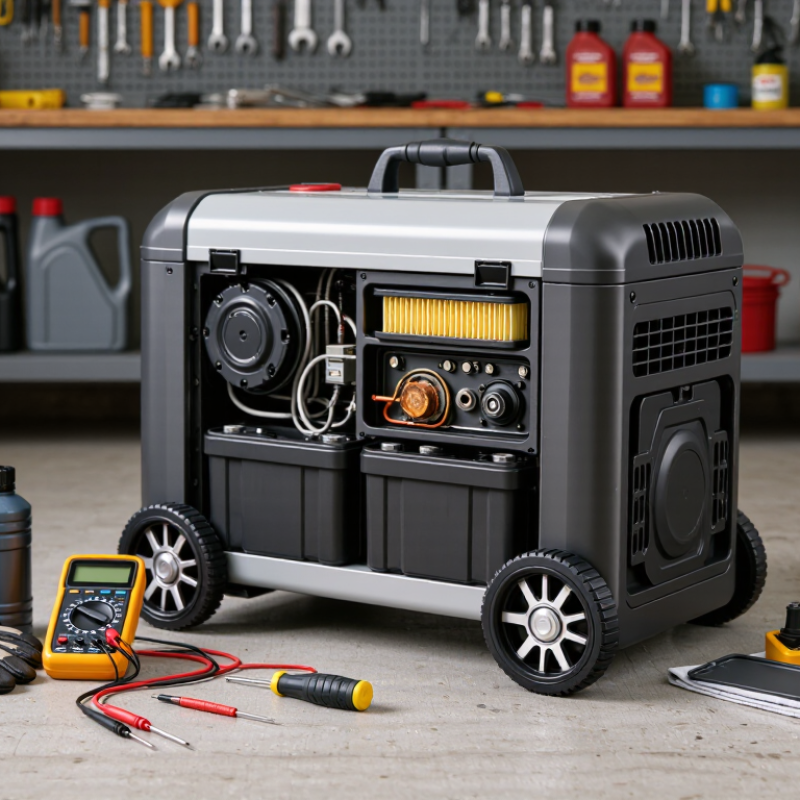
How to Troubleshoot a Generator That Will Not Start?
A generator that will not start often has a simple cause, but simple does not mean harmless. Begin with the fuel supply. Empty tanks, stale diesel, blocked filters, and closed valves can stop combustion. For gasoline units, old fuel may leave varnish around the carburetor. Check the engine oil level too. Some safety sensors prevent starting when oil is low.
The battery is another common failure point. A weak battery may click once without turning the engine. Inspect loose terminals, corrosion, and the charger’s indicator. Then examine the control panel for emergency-stop activation or fault codes. A failed transfer switch can also create confusion, especially when the engine runs but the building receives no power. Uptime Institute’s 2023 Global Data Center Survey reported that 60% of serious outages cost at least $100,000. Generator readiness deserves more than a quick visual check.
Tips: Test the generator under load, not only at idle. NFPA 110 guidance supports regular inspection and operational testing for emergency power systems. Keep a dated log of fuel condition, battery voltage, oil level, and start results. Cold mornings expose weak batteries quickly. A technician should measure cranking voltage and inspect fuel quality before replacing expensive parts. I have noticed that people often blame the starter too early. That assumption can waste time. Never bypass safety controls; follow the service manual and isolate electrical hazards before opening panels.
When a generator will not start, treat the area as a hazard zone, not a repair bench. Move it outdoors, at least 20 feet from doors, windows, and vents, as advised by the U.S. Consumer Product Safety Commission (CPSC). Its 2023 report recorded 799 portable-generator carbon monoxide deaths from 2011 through 2021. Never test the machine in a garage, even with the door open. Carbon monoxide has no smell. That detail is easy to underestimate.
Check the fuel level, shutoff valve, and fuel line before touching the starter. Stale fuel can leave a varnish-like smell and restrict the carburetor. Look for wet fittings, cracked hoses, or fuel beneath the tank. Do not add fuel while the engine is hot. Check the oil level on level ground, because a low-oil sensor may prevent ignition. Inspect battery terminals for white corrosion and confirm the emergency stop switch is released. Small oversights matter.
The Centers for Disease Control and Prevention reports that more than 400 people die annually in the United States from unintentional, non-fire carbon monoxide poisoning. Keep the exhaust outlet clear, and install a working CO alarm nearby, but never use it as permission to operate indoors. I have seen troubleshooting become rushed after one failed start. That is where judgment slips. If fuel smells unusually strong, wiring is damaged, or a safety alarm activates, stop and request a qualified inspection. CPSC and NFPA guidance are useful, but the machine’s manual still deserves careful attention.
A silent generator often has a simple electrical cause. Begin with the battery, because low voltage can prevent the control panel from responding. Measure voltage with a multimeter while the generator is off. A healthy reading should match the battery’s rated voltage. Then check voltage during cranking. A sharp drop suggests a weak battery, poor charging, or excessive starter resistance. Clean the terminals and tighten them carefully. Corrosion can hide beneath an apparently secure connection.
Next, inspect the controls. Confirm that the emergency stop is released and the operating mode allows starting. Check fuses, relays, warning indicators, and low-oil or temperature shutdown sensors. Do not bypass a safety device to force a start. That can damage the engine or hide a dangerous fault. If the control display is blank, trace power from the battery through the disconnect, fuse, and controller. One loose connector can interrupt the entire starting circuit.
Tips: Use a wiring diagram and label each connection before removing it. Test one point at a time. Do not guess. A new battery is not proof that the battery circuit is sound. I have seen clean-looking terminals fail under load, so inspect cable ends closely. Also check the ground cable between the battery and engine block. It may feel tight but still have internal corrosion. Stop testing if cables become hot, insulation melts, or fuel odors appear. A qualified technician should handle those conditions.
Begin with the ignition system, but keep the generator switched off during visual checks. Inspect the spark plug wire for cracks, looseness, or moisture around the connection. Remove the spark plug and examine its tip. A wet electrode may indicate flooding, while heavy black deposits can suggest poor combustion. Replace damaged parts with the correct specifications, not a close substitute. Test carefully. Electrical faults are easy to misread.
Check the air intake next. A clogged filter can restrict airflow and make the engine cough without starting. Hold the filter toward a light; little light means limited airflow. Clean reusable filters properly, and replace damaged paper elements. Look for leaves, dust, or insect nests near the intake screen. I have seen a nearly invisible layer of dust cause repeated starting failures.
Examine the engine system for fresh oil, unobstructed fuel flow, and secure control settings. Low oil protection may prevent starting, even when the engine looks normal. Check the oil level on a level surface, and avoid overfilling. Listen for the starter’s sound. A slow, clicking response often points to a weak battery or poor terminal contact, while normal cranking with no ignition suggests another fault. If fuel smells strong, stop cranking and ventilate the area. Do not guess. Record each inspection and change only one condition at a time.
A generator that refuses to start repeatedly needs more than another battery charge. The first guess is often wrong. Check the fuel level, fuel age, oil level, emergency stop, and control-panel warnings. A weak battery may still show voltage, yet collapse under starter load. Listen for the starter motor, fuel pump, and ignition sequence. Silence suggests a control, battery, or connection fault. Cranking without ignition points toward fuel delivery, air intake, glow plugs, or spark components. NFPA 110 recommends regular inspection and exercising for many emergency power systems, including monthly 30-minute tests under specified conditions. Follow the equipment manual and local requirements.
Persistent failures require professional repair. Technicians can perform a load test, measure fuel pressure, inspect solenoids, test sensors, and verify compression. Do not bypass shutdown switches. Do not keep cranking near spilled fuel. The U.S. Consumer Product Safety Commission reported 765 unintentional carbon monoxide deaths linked to portable generators from 2011 through 2021. Exhaust must remain outdoors, far from doors, windows, and vents. Move the unit only when it is off and cool.
A useful service record includes ambient temperature, fault codes, cranking time, maintenance dates, and recent fuel changes. These details shorten diagnosis. The first repair attempt may still miss a hidden wiring fault. That is why repeated no-start symptoms deserve a qualified technician, especially after flooding, overheating, abnormal smoke, or a failed automatic transfer test. Rescue attempts can create damage.
| Observed Symptom | Likely Cause | Safe Initial Check | Typical Finding | Recommended Action | Professional Repair Indicator |
|---|---|---|---|---|---|
| No sound or response when starting | Discharged battery, loose cable, blown fuse, or start-control fault | Confirm the battery terminals are clean and tight; check the stop switch and circuit breaker position | Starter does not engage or control lights are weak | Recharge or replace the battery if it cannot hold a charge; tighten connections | Battery tests good but the starter remains inactive, or wiring shows heat damage |
| Starter turns slowly | Low battery charge, corroded terminals, undersized cables, or a failing starter motor | Inspect cable ends and measure battery voltage with a suitable meter | Cranking speed is noticeably slower than normal | Clean and tighten connections, then recharge the battery according to the equipment manual | Voltage drops sharply during cranking or the starter produces grinding or burning smells |
| Engine cranks but does not start | Insufficient fuel, blocked fuel filter, closed fuel valve, or air in the fuel system | Verify the fuel level, fuel-valve position, and visible condition of fuel lines | Starter operates normally, but the engine never fires | Use clean, suitable fuel and replace a restricted filter only when the procedure is approved by the manual | Fuel leaks, repeated bleeding is required, or fuel-system components need adjustment |
| Starts briefly and then stops | Low oil level, oil-pressure protection, clogged intake, fuel restriction, or overload | Check the oil level on a level surface and remove obvious obstructions from air inlets | Engine runs for seconds or minutes before shutdown | Correct the oil level, reduce the electrical load, and allow the unit to cool before another attempt | Oil level is correct but the shutdown warning remains active |
| Hard starting in cold weather | Cold-thickened oil, weak battery, incorrect choke or glow-plug operation | Follow the cold-start procedure and confirm the battery is fully charged | Cranking is slow and the engine needs multiple attempts | Use the lubricant grade specified for the ambient temperature and avoid extended continuous cranking | Preheating equipment fails, smoke is excessive, or starting remains difficult at moderate temperatures |
| Repeated clicking during start attempts | Weak battery, poor ground connection, or defective starter solenoid | Inspect the negative cable connection to the engine and listen for a single click or rapid clicking | Solenoid clicks but the engine does not crank | Stop repeated attempts, charge-test the battery, and clean accessible ground connections | A charged battery and sound cables do not produce normal cranking |
| Starting fails after extended storage | Stale fuel, discharged battery, deteriorated fuel lines, or moisture-related corrosion | Check fuel age, battery condition, visible leaks, and signs of rodent or moisture damage | Engine cranks but fuel delivery or ignition is inconsistent | Follow the storage-removal procedure and replace contaminated fuel using approved disposal practices | Fuel system cleaning, carburetor service, or electrical restoration is required |
| Engine will not start with load connected | Excessive starting load, short circuit, or incorrect transfer-switch sequence | Disconnect nonessential loads and follow the correct start-before-load sequence | Generator starts without load but stalls or trips when connected | Reconnect appliances one at a time after stable operation is confirmed | Breaker trips immediately, cables become hot, or the load includes a suspected fault |
| Persistent failure after basic checks | Compression loss, ignition fault, injector problem, control-module fault, or internal engine damage | Record warning lights, fault codes, noises, odors, and the exact starting behavior | The same fault returns after battery, fuel, oil, and load checks | Stop troubleshooting beyond the operator-level procedures and arrange qualified diagnosis | Any fuel leak, electrical arcing, abnormal smoke, severe vibration, or repeated unsuccessful starting attempts |
Low voltage can stop the control panel from responding. Measure voltage while the generator is off. Then measure during cranking. A sharp voltage drop suggests a weak battery, poor charging, or starter resistance. Clean corrosion beneath the terminals. A new battery does not prove the circuit works.
Silence often points to the battery, control system, fuse, relay, or wiring. Check the emergency stop and operating mode. Inspect warning lights and the control display. Trace power from the battery through the disconnect, fuse, and controller. One loose connector can stop the whole starting circuit.
Inspect both cable ends closely. Look for white or green corrosion. Check the ground cable between the battery and engine block. It may feel tight but contain internal corrosion. Test under load, not only at rest. Stop if a cable becomes hot.
Keep the generator switched off during visual checks. Inspect the spark plug wire for cracks, looseness, or moisture. Examine the plug tip after removal. A wet electrode may indicate flooding. Heavy black deposits may suggest poor combustion. Use correct replacement specifications.
Yes. A clogged filter can restrict airflow and cause coughing without ignition. Hold the filter toward a light. Little visible light suggests limited airflow. Check for dust, leaves, or insect nests. Clean reusable filters properly. Replace damaged paper filters.
Check fuel level, fuel age, oil level, and control settings. Place the generator on a level surface before checking oil. Do not overfill. Low-oil protection may prevent starting. A strong fuel smell means stop cranking and ventilate the area.
Slow clicking often suggests a weak battery or poor terminal contact. Normal cranking without ignition suggests another fault. Possible causes include fuel delivery, airflow, spark parts, or glow components. Silence suggests a control, battery, or connection problem. The first guess can be wrong.
Seek professional help after repeated failures, overheating, abnormal smoke, flooding, or failed automatic tests. A technician can test compression, fuel pressure, sensors, solenoids, and starting load. Do not bypass safety shutdowns. Do not keep cranking near spilled fuel.
Test one point at a time. Use a wiring diagram and label every disconnected wire. Record fault codes, cranking time, temperature, and recent fuel changes. Stop when insulation melts, cables heat, or fuel odors appear. Guessing sometimes hides the real fault.
When a generator will not start, begin by identifying common causes such as stale or insufficient fuel, a weak battery, a closed fuel valve, an overloaded circuit, or an engaged safety shutdown. Before troubleshooting, place the generator in a well-ventilated area, turn off connected equipment, and review its operating instructions. Check the fuel level and condition, inspect for leaks, and confirm that the switches, controls, and electrical connections are properly positioned and secure.
The next steps in how to troubleshoot a generator that won't start include testing the battery voltage, examining the terminals, and checking fuses, wiring, and grounding connections. Inspect the spark plug or ignition components, air filter, fuel delivery system, and engine oil level. If the engine cranks but does not run, or if unusual sounds, warning indicators, or repeated shutdowns occur, avoid forcing additional start attempts. Persistent problems may require professional diagnosis and repair to prevent further damage and ensure safe operation.
Gods Power