Why Is My Diesel Generator Smoking Black?

Time:2026-10-25 Author:Liam
0%

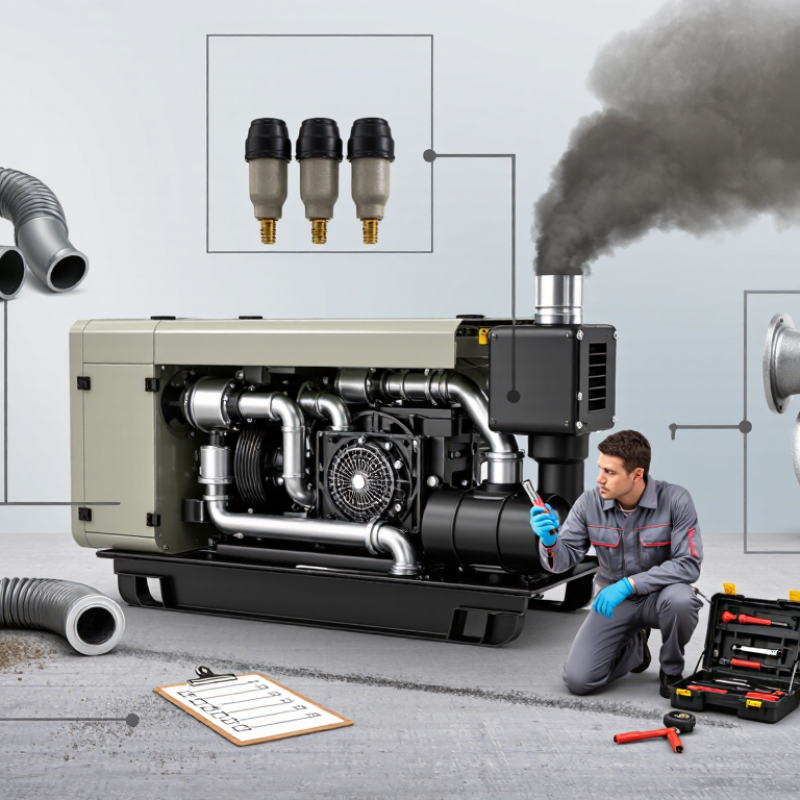
When a diesel generator releases thick black smoke, the exhaust is showing an incomplete combustion problem. The question “why is my diesel generator smoking black” usually points to too much fuel or too little air. A brief dark puff during startup may be normal. Continuous smoke is different. It needs attention.

In real maintenance work, technicians often begin with simple checks. A clogged air filter can restrict airflow. A damaged intake hose may collapse under load. Dirty injectors can deliver an uneven fuel spray. A faulty turbocharger may also reduce available air. Each issue leaves different clues, such as poor acceleration, higher fuel use, rough running, or a strong diesel smell. The exhaust may even stain nearby walls with dry soot. Small details matter.

Do not guess too quickly. An overloaded generator can smoke when its demand exceeds the rated output. Old fuel, incorrect injector timing, and poor servicing can create similar symptoms. Check the manufacturer’s manual and record when the smoke appears. Note the load percentage, engine temperature, fuel condition, and recent repairs. Those details help a qualified technician test the system safely. Avoid removing fuel lines or opening high-pressure components while the engine runs. Diesel injection pressure can cause serious injury.

A visual inspection is useful, but it is not a complete diagnosis. Black smoke may have more than one cause. That is easy to overlook. Proper testing should confirm airflow, injector performance, turbocharger operation, and engine condition. Acting early can reduce soot buildup, fuel waste, and expensive damage.
Why Is My Diesel Generator Smoking Black?

What Black Smoke Means: Soot Forms Below Diesel’s ~14.5:1 Stoichiometric AFR

Why Is My Diesel Generator Smoking Black?

Black smoke usually means the engine is receiving more fuel than the available air can burn. Diesel combustion becomes visibly sooty when the local air-fuel ratio falls below the approximate 14.5:1 stoichiometric ratio. That figure matters. It represents the theoretical balance for complete combustion, not the normal operating ratio of a diesel generator. Diesel engines usually run with excess air, especially at moderate loads. Under heavy load, however, a blocked air filter, restricted intake, weak turbocharger, or faulty boost hose can reduce oxygen quickly.

I have seen a generator produce a dark cloud when a dirty filter looked only slightly discolored. The engine sounded normal at light load. The smoke appeared when several electrical loads started together. Another common cause is excessive fueling from a worn injector or incorrect injection control. Poor atomization can leave large fuel droplets, creating carbon-rich zones inside the cylinder. These zones burn incompletely and exit as black soot. The exhaust tells a story.

A technician should inspect the air path, intake pressure, injector condition, and load profile before replacing parts. Measuring exhaust opacity and exhaust temperature can reveal changes that eyesight misses. Check for loose clamps and collapsed hoses. Do not assume the fuel system is at fault first. I once focused on fueling and overlooked a nearly blocked intake screen. That mistake cost time. Black smoke under sudden load may be brief, but persistent smoke suggests an air-fuel imbalance that deserves testing.

Air-System Checks: Replace Filters at the OEM Restriction Limit, Often 5–10 kPa

Why Is My Diesel Generator Smoking Black?

Black smoke often means the engine receives too little air for the fuel injected. Begin with the air system, not the injection pump. Check the filter, intake hose, clamps, turbocharger inlet, and restriction indicator. A collapsed hose can look harmless from outside. It may still starve the engine.

Replace the filter when restriction reaches the engine manufacturer’s stated limit. Many generator applications specify approximately 5–10 kPa, or 20–40 inches of water. Do not replace filters only by appearance. Dust loading can be hidden inside pleats. SAE J726, Air Cleaner Test Code, defines restriction testing methods, while ISO 5011:2014 provides laboratory procedures for air-cleaner performance and dust-loading measurement. These standards support measured servicing, not guesswork.

Measure restriction under full rated load, using a calibrated gauge near the engine intake. Record ambient temperature, load percentage, and reading. High altitude and dirty pre-cleaners can change results. A clean-looking filter may still restrict airflow. I once treated a dark filter as the main fault, but a loose intake clamp caused the smoke. That mistake was expensive. If restriction remains normal, inspect the turbocharger, charge-air leaks, exhaust backpressure, and injector condition. The 5–10 kPa range is useful, but it is not universal. The applicable service manual remains the controlling technical reference.

Fuel-System Checks: Injector Pressures Commonly Reach 1,000–2,500 bar

Black smoke usually means too much fuel, too little air, or poor atomization. Injector pressure deserves careful attention. Modern high-pressure diesel systems commonly operate between 1,000 and 2,500 bar, according to technical reviews published in Fuel and SAE International literature. That pressure creates a fine spray, but pressure alone does not prove injector health.

Measure pressure during cranking, idle, and load. Compare each reading with the engine service specification. A weak pump, restricted filter, leaking return circuit, or worn injector can reduce effective pressure. The International Organization for Standardization’s ISO 8178 test procedures also show why load matters: diesel emissions can change sharply when operating conditions change. Black smoke may appear only when the generator accepts a heavy electrical load.

Look closely. Wet injector tips, uneven exhaust pulses, or a sharp fuel knock deserve attention. Check the air filter, turbocharger, intake hose, and charge-air cooler before condemning the fuel system. A restricted intake can mimic injector overfueling. The U.S. Environmental Protection Agency’s nonroad diesel emission requirements emphasize particulate control, but field diagnosis still depends on actual engine measurements. High-pressure fuel can penetrate skin without leaving a visible wound. Use rated test equipment and trained procedures. My own caution is simple: replacing injectors first feels efficient, but it often wastes money when airflow is the real fault.

Why Is My Diesel Generator Smoking Black?

Fuel-system checks: diesel injector pressures commonly reach 1,000–2,500 bar.

What black smoke usually means: Black smoke indicates incomplete combustion, commonly caused by too much fuel or too little air. Restricted air filters, turbocharger problems, poor injector spray patterns, incorrect fuel delivery, or low injection pressure can contribute. Compare measured injector pressure with the engine manufacturer’s specification before replacing components.

The pressure ranges shown are representative peak injection-pressure ranges for common diesel fuel-system designs. Exact values vary by engine, operating condition, and system calibration.

Load and Timing Tests: Keep Gensets Above 30% Load to Limit Wet Stacking

Black smoke from a diesel generator often signals incomplete combustion, not simply bad fuel. When the engine runs lightly, fuel quantity may exceed efficient combustion. Unburned fuel can wet exhaust surfaces and leave oily carbon deposits. This condition is commonly called wet stacking. I have seen a clean-looking generator smoke heavily after weeks of light standby testing. The exhaust tip was sooty, while the engine oil level slowly rose. That finding needs inspection, not guesswork.

Keep the genset above 30% load when operating conditions allow. This threshold is a practical field guide, not a universal cure. A load bank can apply steady, measurable demand during maintenance tests. Record load percentage, exhaust temperature, voltage, frequency, and smoke changes. If smoke decreases as load rises, poor loading deserves attention. Short tests may not remove deposits. A longer, controlled run may reveal the actual pattern. Do not burn it out blindly.

Injection timing matters too. Retarded timing can lower combustion temperature and increase black smoke. A qualified technician should verify timing using the correct service procedure and instruments. Never adjust timing by ear or smoke alone. Check air filters, turbocharger condition, injectors, and fuel quality before blaming load. A restricted intake can create the same dark plume. So can a worn injector.

Keep a simple test log. Note ambient temperature and altitude. These details are easy to miss. I once treated load as the whole answer; it was not. The generator still smoked because one injector spray pattern was poor. That mistake changed my inspection sequence.

Emissions Verification: EPA Tier 4 PM Limits Can Be as Low as 0.02 g/kWh

Why Is My Diesel Generator Smoking Black?

Black smoke usually means incomplete combustion. Too much fuel, too little air, or poor injection timing can create visible soot. A clogged air filter, damaged turbocharger, overloaded generator, or cold cylinder may produce the same dark plume. Field technicians often find that a generator can sound normal while its particulate emissions rise sharply. That is easy to miss.

EPA Tier 4 verification makes this issue more precise. For some nonroad diesel engine power categories, the EPA limit for particulate matter is as low as 0.02 g/kWh, according to 40 CFR Part 1039. The EPA’s Nonroad Compression-Ignition Engine report explains that Tier 4 controls target both PM and nitrogen oxides. Visible smoke alone cannot confirm compliance. ISO 8178 laboratory procedures, dilution sampling, and gravimetric PM testing provide stronger evidence. Portable emissions measurement systems can also reveal problems during real loads. A clean exhaust is not proof. This is where maintenance assumptions can fail.

Tips: Record exhaust appearance, load percentage, ambient temperature, and fuel condition. Check intake restriction and turbocharger response before replacing injectors. Compare test results with the engine’s certified emission values. The International Council on Clean Transportation has reported that real-world diesel emissions can differ from certification results, especially under changing loads. Repeat testing after repairs. One test can mislead.

FAQS

What does black smoke from a diesel generator usually mean?

It usually means too much fuel for the available air. The mixture becomes oxygen-poor. Soot then leaves through the exhaust.

Why does smoke appear when several loads start together?

A sudden load increase demands more fuel immediately. A restricted intake may not supply enough oxygen. The exhaust can turn dark within seconds.

What air-system parts should technicians inspect?

Check the air filter, intake hose, clamps, turbocharger inlet, and boost hoses. Look for collapsed hoses and loose connections. A harmless-looking clamp caused my wrong diagnosis once.

When should an air filter be replaced?

Replace it when measured restriction reaches the engine manufacturer’s limit. Many systems use roughly 5–10 kPa. Appearance alone is unreliable. Dust may hide inside the pleats.

How should intake restriction be measured?

Measure near the engine intake during full rated load. Use a calibrated gauge. Record load, temperature, altitude, and restriction. A clean filter can still restrict airflow.

Can light loading cause black smoke?

Yes, especially during repeated standby testing. Low load may leave unburned fuel and carbon deposits. This condition is often called wet stacking. Do not assume it is the only cause.

How can loading be tested safely?

Operate above about 30% load when conditions permit. A load bank provides steady, measurable demand. Record exhaust temperature, frequency, voltage, and smoke changes. Short tests may hide the real pattern.

Can injector problems create black smoke?

Yes. A worn injector may deliver poor spray patterns or excessive fuel. Large droplets create fuel-rich zones inside the cylinder. Check the injector after examining the air path.

Can injection timing cause dark exhaust?

Retarded timing can reduce combustion temperature and increase soot. A qualified technician should verify timing with proper instruments. Never adjust timing by ear or smoke alone. I once blamed loading too quickly.

Conclusion

If you are asking, “why is my diesel generator smoking black,” the most likely cause is incomplete combustion. Black smoke forms when the engine receives more fuel than the available air can burn, producing soot below diesel’s approximate 14.5:1 stoichiometric air-fuel ratio. Begin with the air system by inspecting the intake, filter, turbocharger, and charge-air path. Replace filters when they reach the manufacturer’s restriction limit, which is often around 5–10 kPa.

Next, check the fuel system, including injector condition, spray pattern, and injection pressure; modern diesel injectors commonly operate at approximately 1,000–2,500 bar. Excessive load, incorrect timing, or poor injection can also increase smoke. Keep generator sets above roughly 30% load when practical to reduce wet stacking, while avoiding overload conditions. Finally, emissions testing can confirm the issue, especially where stringent standards apply; some Tier 4 requirements limit particulate matter to as little as 0.02 g/kWh. Consistent maintenance and measured diagnostics are essential for identifying the actual source.

Liam

Liam

Liam is a dedicated marketing professional with a profound expertise in the industry, where he excels at highlighting the unique advantages of our core products. With a keen understanding of market trends and consumer needs, Liam frequently updates our company’s professional blog, providing......